
Our six-step interior design process
Structure, creativity and careful thinking – from the first conversation to the day you walk into your finished home.
A well-designed home doesn’t happen by accident. It’s the result of the right decisions being made in the right order, and a process that keeps everything connected from the first conversation to the final installation.
Our six-step process exists to bring that structure to your project. You’ll always know what’s happening, what’s coming next, and what’s being decided on your behalf. No surprises, no chasing – just a well-managed project that leads to a home you’re genuinely proud of.

Step 1: Foundations
Getting to know you and your home
This is where everything begins – and it’s the step that shapes everything that follows.
Before a single design decision is made, we need to understand two things properly: your home and the people who live in it.
We visit the property to carry out a thorough site survey – measuring, photographing and assessing the space in detail. At the same time, we spend time with you understanding how you want to use your home day to day. Not just the practical requirements, but the things that are harder to articulate – how you want it to feel, what you’re drawn to, what you’d rather never see again.
We talk about the rooms you’ve always loved, the ones that have never quite worked, and everything in between. Your lifestyle, your routines, your instincts about colour and comfort and space.
This isn’t a polite getting-to-know-you conversation. It’s the detailed information gathering that makes every subsequent decision more considered and more personal. The more honestly you can tell us what you want – and what you don’t – the better the design that follows.
By the end of Step 1, we have a thorough understanding of your brief, your property and your aspirations. The design work begins in Step 2.
|
|
Step 2: Concept & Spatial Design
Layouts and design direction
With the brief firmly in place, we begin shaping the design. This is where spatial thinking happens – how rooms connect, how the house flows, how each space will function day to day.
We develop floor plans and layout options, exploring how the property can work better for the way you live. Where relevant, we also begin introducing the high-level design direction – the overall feel, the mood, the palette of ideas that will underpin the scheme.
Your feedback at this stage is essential. Once the layout and broad direction are agreed, we move forward into the detail with confidence.
|
|
Step 3: Detailed Design
The full scheme, developed and costed
This is where the design comes together as a complete picture – every element considered, specified and presented so you can see exactly how your home will look and feel before anything is committed.
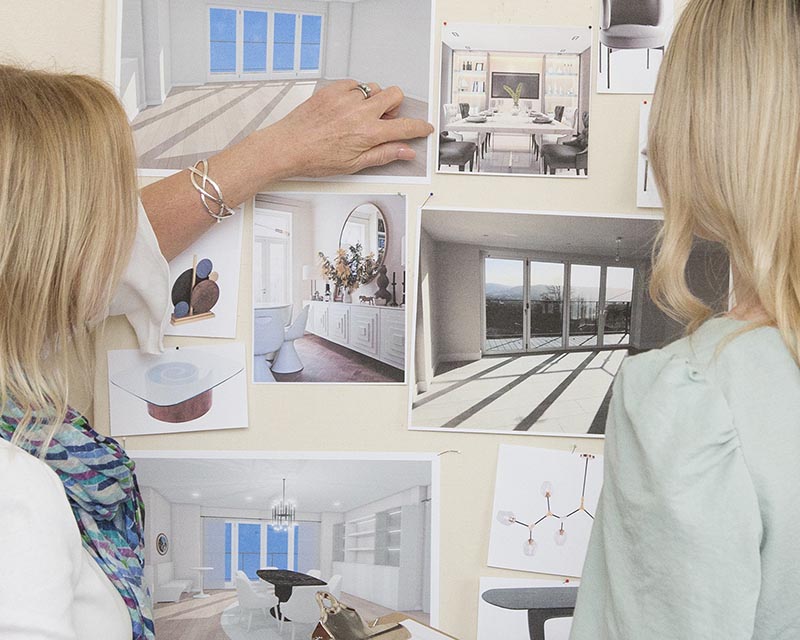
Colour schemes, materials and finishes are confirmed. Furniture, lighting and furnishings are selected and presented as a cohesive scheme, brought to life through detailed room collages showing how each space will look. Joinery and cabinetry designs are developed to a level where you understand what you’re getting and what it will cost – the detailed workshop drawings follow in Step 4, once everything is agreed.
Lighting is planned and costed at this stage too. The electrical drawings and final specifications are produced in Step 4, again once the design has been signed off and changes are unlikely.
This sequencing is deliberate. We develop the design far enough to make confident, informed decisions – without committing to the level of detail that becomes expensive to revisit if something needs a small adjustment.
For clients who want to see the spaces in full three dimensions before signing off, our Studio Principal tier includes immersive 3D visuals at this stage – showing materials, furniture and finishes in context, from multiple viewpoints, so there is no ambiguity about what you are agreeing to.
By the end of Step 3, you have a fully developed scheme and a detailed cost breakdown. Nothing moves to procurement or detailed technical drawing until you are happy and everything is agreed.
|
|
Step 4: Procurement & Programme
Technical drawings, ordering, planning and coordination
With the design signed off, Step 4 has two distinct parts that run in parallel.
The first is technical development. Workshop drawings for bespoke joinery and cabinetry are produced in full detail, giving makers and craftsmen exactly what they need to build to specification. Electrical drawings and final lighting plans are completed and issued to your electrician or contractor. Any other technical specifications that couldn’t be finalised before sign-off are resolved here.
The second is procurement. We place orders with suppliers, track lead times, coordinate deliveries and manage the logistics of getting everything to site at the right time. Nothing is left to chance and nothing falls through the gap between design and delivery.
You won’t be chasing orders or fielding calls from suppliers. We handle all of it – so the project keeps moving without the administration falling on you.
|
|the
Step 5: On-site Works
Implementation and site coordination
Now the transformation takes shape. Whether we are managing the trades directly or working alongside your appointed builder, we remain closely involved throughout; carrying out site visits at key stages, protecting the design intent and ensuring the work is being delivered as planned.
Where decisions need to be made on site, we make them quickly and correctly. Where problems arise (and in any building project, some always do) we resolve them without drama and without involving you in every detail unless your input is genuinely needed.
Step 6: Completion
Installation, reveal and handover
This is the part clients remember most.
Once site works are complete, we return to install all furnishings, lighting, soft furnishings and finishing details – every element placed exactly as designed. Installation day is a coordinated effort, and it’s one of our favourite parts of the process.
When everything is in place, we invite you to see the finished home. Final snagging is taken care of, the project financials are presented, and we hand over a home that is complete – nothing on order, nothing outstanding, nothing left to figure out.
Aftercare support is available once you’re settled, should anything need attention.
How the process connects to our services
Whether you’re renovating with a builder and architect, or furnishing a new home from scratch, the process is the same. What changes is the delivery context, and we’ll explain how that works for your specific project when we speak.
If you’re not yet ready to commission a full project, our Project Scoping Session is a good place to start – a focused session to define scope, budget and sequence before the design work begins.
Tell us about your project →
Find out about the Project Scoping Session →
“I chose Julia because she was very professional, friendly and knew how to interpret my needs. Her designs are gorgeous but totally practical.”
Awards


Contact
The House Ministry Limited
Eagle Tower
Montpellier Drive
Cheltenham
Gloucestershire
GL50 1TA
United Kingdom
RENOVATION GUIDE
It's the expert insight you won't find on Pinterest, from a studio that designs and delivers some of the Cotswolds most elegant homes.
For you, with our compliments

SOCIALS
Follow along on social media for design insights, practical advice, and a closer look at our latest projects.